


We just have a few questions before you get started.

The first step to achieving savings goals is to set some for yourself. After reflecting on your current savings status, it’s a good idea to set both short- and long-term goals.
Select a response. Submit your response.
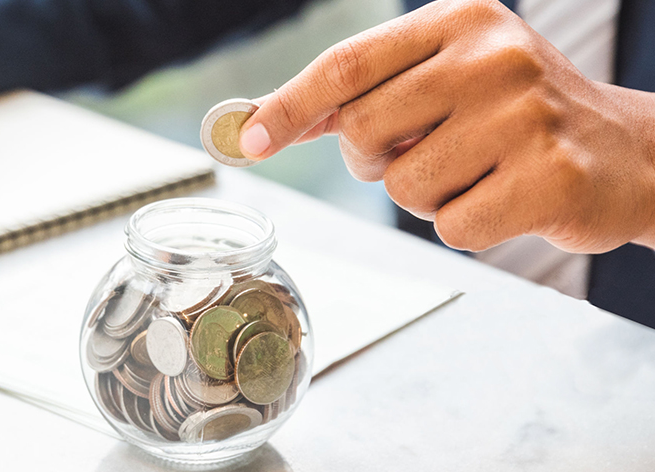
Only about 48% of families have liquid savings equal to three or more months of expenses, and just 27% have more than six months. If you are among those who are struggling to build savings, it may be helpful to review why savings, even in small amounts, is important.
Review the five slides.
A common method of figuring out how to budget is the 50-30-20 rule, which recommends that you spend 50% of income on needs, 30% on wants, and 20% on savings or debts.
Use the calculator to determine how much you should be spending if you follow the 50-30-20 rule recommendation. Calculators are for educational purposes only.
Research has shown that “earmarking” and partitioning funds into two accounts increases savings rates among low-income consumers. But where could you put your money?
Select the five topics.
A type of savings account that may require a large initial deposit, generally has a higher
interest rate, and may have limited access.
CDs are intended to hold a fixed amount of money for a fixed period. While these accounts usually offer higher interest rates than traditional savings accounts, your
money is not as accessible because it must remain in the account for a fixed period, usually referred to as a “maturity period.” Typical maturity periods are six months, one year, and five years. Withdrawing funds from a CD before this period ends may result in
a penalty fee.
Offered by banks, Money Market Accounts may require a minimum initial deposit. You typically have to maintain a minimum balance, and banks may limit the number of certain types of transactions allowed in a month. If you exceed the transaction limit, a bank may charge an “excess transaction fee” or convert the account into a checking account. Money Market Accounts typically offer lower interest rates than certificates of deposit, but the cash is more accessible.
These funds are available through investment companies. They generally provide higher returns than interest-bearing bank accounts and invest in safer investments, but returns aren’t guaranteed or insured by the government.
A bond is a debt investment. When you purchase a bond, you are lending money to someone else (known as the issuer). In exchange, the bond issuer pays back the original amount (known as face value) and also interest for a specific period. Bonds aren’t always low risk; the interest rate is laid out but not necessarily fixed, and interest plus the face value is paid back.
Is there a young person in your life? Developing wise financial habits at an early age can help encourage responsible decision making and a healthy relationship with money before adulthood. Most banks and credit unions allow minors—people under 18 years old—to open accounts with a parent, guardian, or other adult.
Select the three tabs.
These accounts provide minors with a banking account option, but the account is technically still jointly owned by the minor and their parent or guardian. Sometimes these accounts are set up so that the minor must receive authorization from their parent or guardian to make withdrawals. The adult account holder may set up alerts to be notified when a minor uses the account, and the account details and fees may change when the child reaches the age of 18.
A parent or guardian opens and manages these accounts on behalf of a minor. The funds in these accounts legally belong to the minor, so the custodian cannot use the money, other than for withdrawals or investments for the minor’s benefit. Once the minor becomes an adult, they take full ownership of the account.
A 529 Plan is a special savings plan sponsored by states or educational institutions. These plans provide tax advantages and allow you to open an account to save for someone’s education costs, be it tuition in secondary and primary school, books and supplies at a college or university, or even tuition credits at in-state public colleges and universities.
When you deposit money into a savings account, you are essentially acting as a lender to the financial institution you bank with. This financial institution will typically pay you a percentage of your balance to keep your money with it — this is called interest.
Select play to start the video.
Procedures may vary by individual financial institution, but as a guideline, use this checklist to help you prepare to open a checking or savings account
Select the five steps.
There are many savings options available, and it’s important to decide which option is the best fit for you and your savings goals.
Visit your bank or credit union either online or in-person to see what options they provide and to open a new account.
These generally could include a driver’s license, passport, birth certificate, Social Security card, or other form of government-issued ID.
This includes your address, phone number, and email address. Remember, be sure to review and confirm the accuracy of your address on any checks. Sometimes people use an alternate mailing address so as not to print their home address on their checks.
Have cash or a check with you to make your first deposit. Remember, there may be a minimum amount required to open an account.
A typical savings account allows you to deposit and withdraw money, but there are limits on how many monthly withdrawals you can make. Depending on the savings account you choose, your financial institution may also require you to maintain a minimum balance.
Savings accounts are useful for putting money aside for wants, emergencies, or a rainy day because they generally have higher interest rates than checking accounts. Make sure you set short- and long-term goals for yourself so that you know what you are saving toward.
With a savings account, you take on the role of the lender and the financial institution becomes the borrower. The higher the interest rate and the longer the time period you leave your money in an account, the more compound interest you earn.
We just have a few questions before you get started.
Set savings goals for the short-term, for the long-term, and for specific major life events, such as retirement, education, or emergency savings.
Create a budget and identify what money you have available to set aside for savings.
Consider opening a savings account that will help meet your personal financial goals.
Talk to a representative at your financial institution to learn more about the options available to you.